I love visiting bothies, and what with one thing and another, it had been a good few months since I last visited one. As I’m currently not very busy, but about to get stuck into a major new work project that will occupy me for several months, I was keen to get a couple of days away in peaceful surroundings.
So, plans were made. Feeling a little out of shape recently, I didn’t fancy anything that was going to be a particularly difficult hike, and with a special offer from ScotRail allowing me to go anywhere for £19, I decided a bothy-by-train adventure was called for. I did a bit of research, and a lot of thinking, but eventually settled for a bothy I’ve visited before – Gleann Dubh-Lighe, a fairly easy hike from Glenfinnan station on the West Highland line.
This ticked plenty of positive boxes for me. An epic train journey would be followed by some time to relax and unwind in a lovely little bothy in stunning surroundings. There were a couple of downsides that almost put me off – part of the hike in is along a fairly busy road, and I rather fancied visiting a new bothy, but I was getting indecisive about which new bothy to visit. This is a common problem for me – when I plan a trip, I have a tendency to get very overthinky about it, and I then have a crisis of confidence that stops the trip from happening.
This often starts at the packing stage, when I end up worrying about what to take (and not to take). In an effort to overcome this, I’ve drawn up the Definitive Bothy Packing List, which I hope will help me not to forget any essentials, and not to take crap I don’t need. Weight is an important consideration. My hike in to the bothy on this trip is about four miles, something I can very easily do at a brisk pace, but with an enormous backpack, it’s a different matter entirely. Anyway, having tried out the list, I think it works pretty well, and I’m pleased with how it went this time.
Having done lots of overthinking, I claimed victory over my inertia, and on Tuesday morning, I was ready for my expedition. I drove to Linlithgow, then took a train to Glasgow Queen Street, ready to take the midday West Highland Line train to Glenfinnan.
The West Highland is widely considered to be among the most scenic rail journeys in the world, and I won’t argue with that. Even before the train is properly out of the Glasgow suburbs, the views start getting better and better, and once the West Highland Line proper begins in Helensburgh, the natural grandeur on display is absolutely relentless. It’s a long journey – Glasgow to Glenfinnan takes four and a half hours – so I always make sure I have something to read, but I never end up needing it. There’s always plenty to gawp at out of the window, with lochs, mountains, forests and moors galore. The stations en route provide excellent access to pretty remote areas as well, places you’d possibly struggle to reach any other way.
The most famous of these is Corrour. Approximately 17 miles from the nearest public road, it’s the most remote railway station in the country. As a result, it’s surprisingly busy, with a fair few people boarding and alighting on every train I’ve taken through it. As well as the stunning scenery of Rannoch Moor, there’s shedloads of mountains to climb for the terminally over-energetic, some luxurious places to stay in the old station signal box, and more basic options available in the form of Loch Ossian Youth Hostel, and several excellent bothies. I’ve also hiked between Corrour and Rannoch stations. It’s a long walk, but a fairly easy one, and well worth doing. Here’s a video of Vicki Pipe and Geoff Marshall doing it, albeit in the opposite direction.
Rather incongruously, there’s also a bar and restaurant at Corrour that’s a destination in itself. I worked in Fort William a couple of years ago, and people would go there by train for evening meals. The food is fantastic, and it’s well worth a visit for that reason alone, and justifies the trip if you’re not particularly outdoorsy.
I should also mention that Corrour is famous for this epic cinematic moment…
Anyway, my journey continued to Fort William and beyond. Glenfinnan is, of course, famous for its spectacular viaduct, one of the first major structures in the world to be made of concrete. It’s hugely popular with Harry Potter fans, and vast hordes of people descend upon it every single day to view and photograph trains crossing it. This is still going on, despite The Jacobite steam train not running at the moment. This is a long story, but it’s entirely the fault of the cowboy outfit that runs it, despite their efforts to blame everyone else. It hasn’t put people off flocking to the area, though, although that’s partly down to it being a big stop on coach tours.
Alighting at Glenfinnan just before 5pm, I shouldered my pack and started my hike to the bothy. There’s several interesting things to see along the way. First off is Saint Mary and Saint Finnan church, which is in a beautiful setting overlooking Loch Shiel. It’ll also look familiar to anyone who has seen 28 Years Later, featuring at the start of the film. Moving on, there’s great views of the loch, the Glenfinnan Monument, and of course, the viaduct.
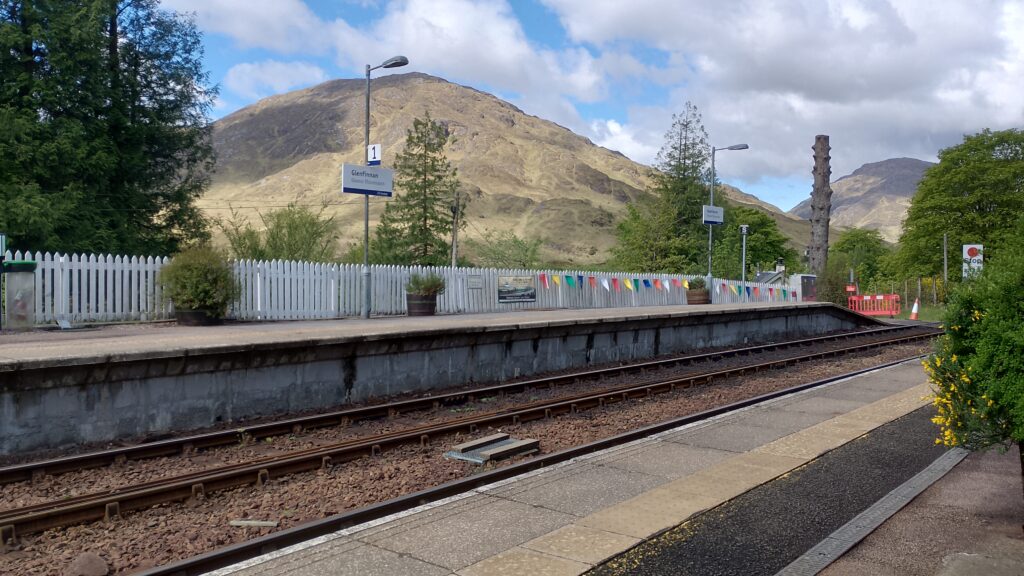
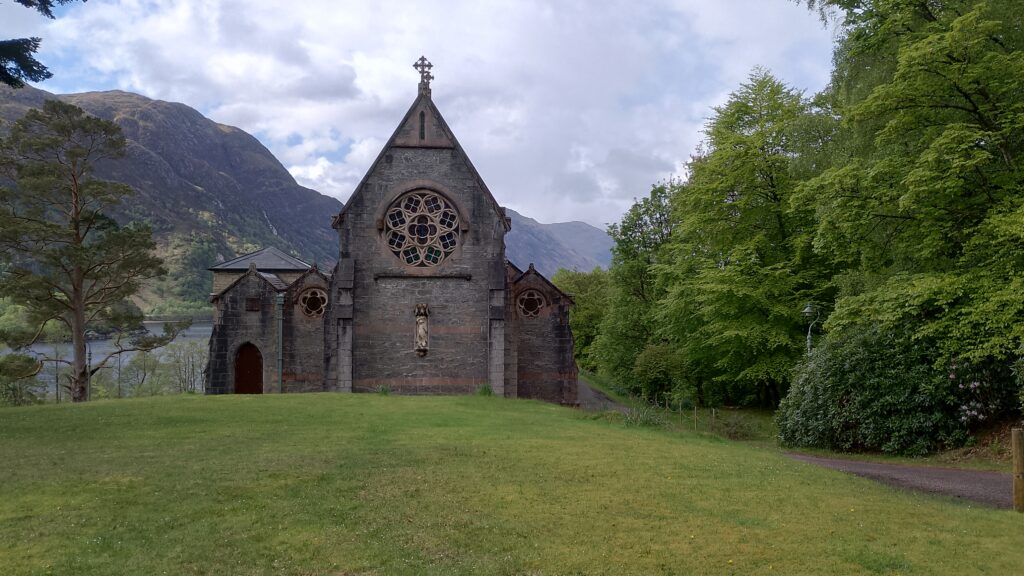
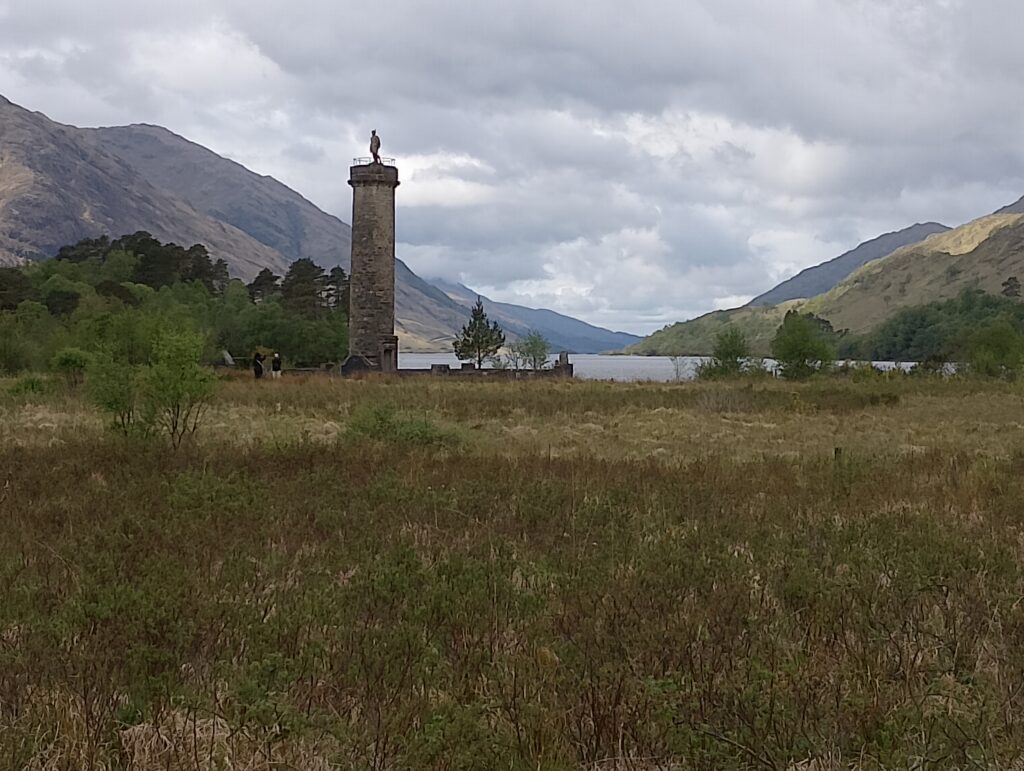
Most of the initial hike here is along a road, and that first part is OK because there’s a pavement. There’s then a trail that goes away from the road for a bit, which is good, but I then headed back on to the road for the next bit of the hike. Looking at my GPS, though, it did look like there was an alternative route that avoided the road for a significant part of the way. I was a bit uncertain about trying it on this occasion, as it looked like a longer route, and I was keen to make it to the bothy fairly quickly, as the weather was showery. I made a mental note to try it on my way back.
Once the slog along the road is finished, which certainly isn’t bad as these things go, there’s about a mile and a half to go up an estate track which runs alongside a spectacular river with waterfalls aplenty. Suits me, the sound of flowing water is my absolute favourite thing, I find it incredibly relaxing. There’s some quite steep uphill bits, but generally it’s solid underfoot and a very nice walk indeed, so it’s possible to leave the road behind and really enjoy being in a beautiful place.
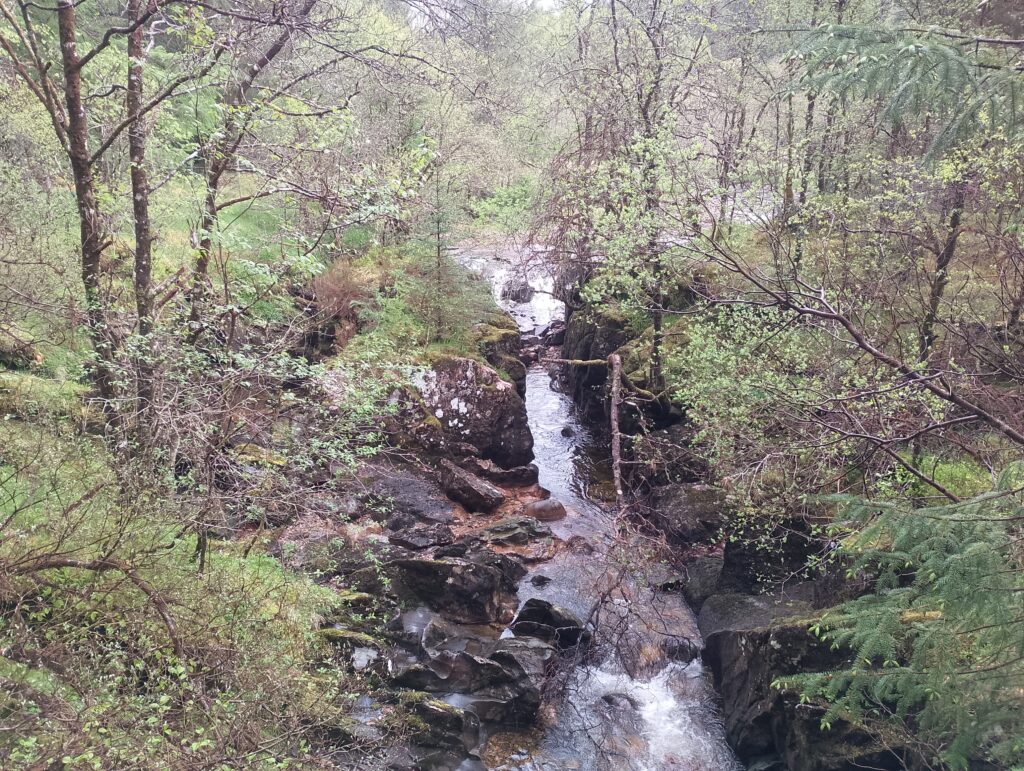
I reached the bothy in slightly under two hours, hurrying a bit towards the end as it rained for the final twenty minutes or so. As I approached, I smelt woodsmoke in the air, so it seemed I’d have company, and I arrived to find three German guys and a French woman warming themselves around a roaring fire. They were all interesting people, so we all had plenty to talk about. The French lady hadn’t visited a bothy before, and seemed quite charmed by the experience. One of the Germans generously shared his whisky with me, so it was an excellent convivial evening, with the fire warming us all.
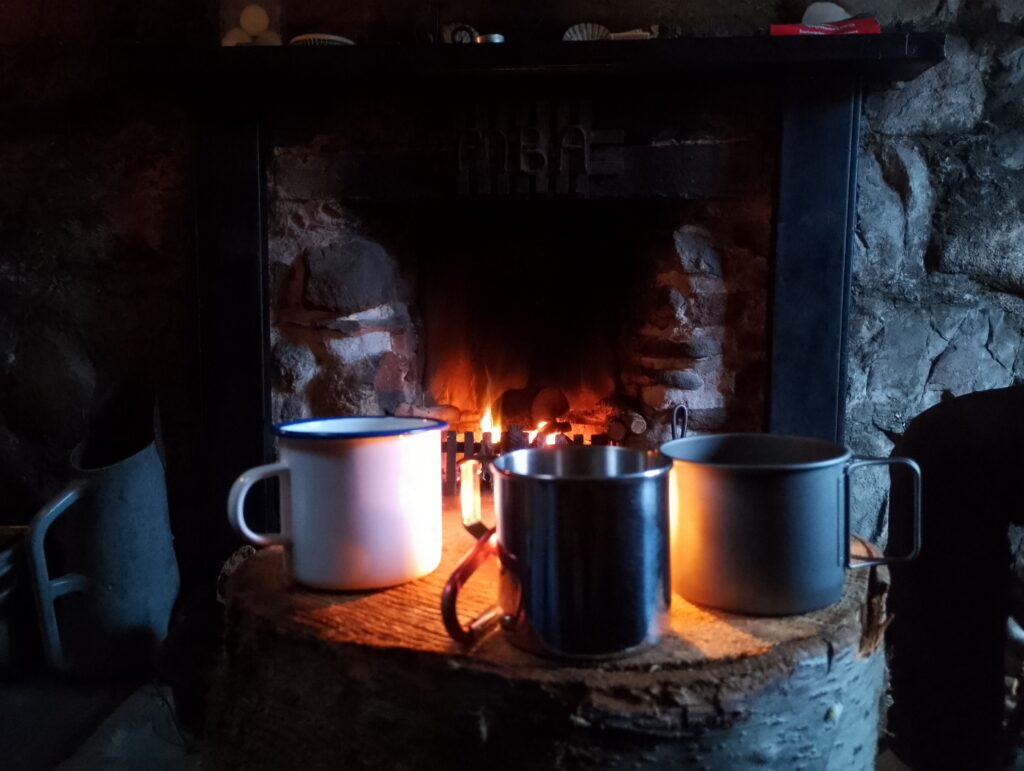
The bothy itself is rather smart, with lovely wooden panelling in both rooms. It was largely destroyed by a major fire about fifteen years ago, but was extensively rebuilt afterwards, and it’s now one of the nicest bothies I think I’ve ever stayed in. It’s got a plentiful supply of wood nearby, an excellent source of clean water, and some stunning mountain views. It gets quite busy, but it’s not as well-used as bothies on long-distance walking routes.
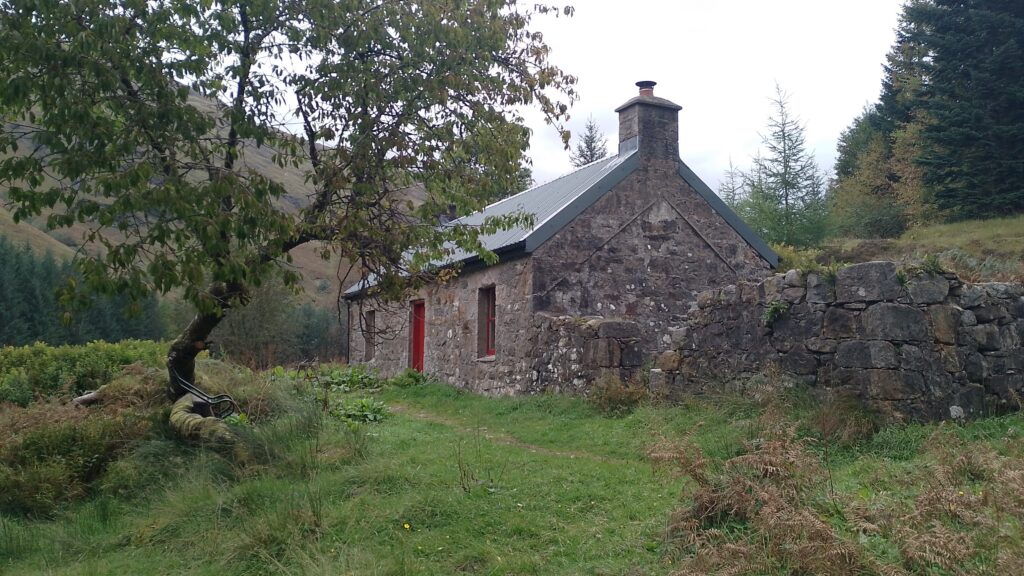
There’s two rooms in the bothy, but only one has a fireplace, so we all slept in that one. There was plenty of room for us all, though. My companions for the night all left early in the morning, to get the train to Mallaig, and the ferry onwards to Rum. Once they’d left, peace descended, and besides a couple out walking who briefly popped in around lunchtime, I had the place to myself for the rest of my stay. Excellent!
Well, I did have one companion, who made several appearances. Mice live in most bothies, and it’s common to hear them scuttle about, but on this stay, I saw one emerge on several occasions. I know most people don’t like them, and consider them a nuisance, but the thing was too cute for me to hold anything against it. It was the first time I’d actually seen a mouse appear.
I did what I usually did in bothies – get a fire going, read, relax, and generally slow right down. The absence of a reliable phone signal in just about every bothy is the best thing about them. I always feel my blood pressure drop almost instantly when I’m in them, and my life returns to what must be an old-fashioned, pre-tech rhythm. Meal times and bedtimes are dictated by nature, simple tasks take up time and feel almost meditative, and the peace is such a boon. I was surrounded by the sounds of water and birdsong, punctuated by the occasional sounds of rain on the roof, and it was just perfect. I read, journalled, thought, took naps, and went outside to just stare on plenty of occasions.
On my second night, it was a bit cold and I was struggling to keep a decent fire going, so I went to bed very early, and for once in my life, I conquered the horror of insomnia, sleeping deeply until morning light penetrated the bothy.
Although I slept well, I’ll be honest and say these aren’t generally comfortable places, and if you prefer the luxuries of hotels (proper bed, indoor plumbing, electricity, lack of mice etc) I can’t say I blame you at all. Bothies are often dirty, dark, cold and a bit grim. I have occasional moments – and I had them on this trip – when I wonder why I like visiting them. On some occasions, those thoughts extend into wondering if I like them. Usually a quick look outside helps, though – they make access to absolutely incredible landscapes so easy.
I packed up and left on Thursday morning. The schedule is dictated by ScotRail’s timetable, as services on the West Highland Line are sparse. There’s a train from Glenfinnan to Glasgow at 11.01, but the next one after that is at 16.54, and that results in a very late arrival at home. I was keen to leave in time for the earlier train. I managed it quite easily, and that was a relief.
I took the alternative, non-road walk back, which is mainly along a forestry track, and it was a thousand times better. It didn’t feel noticeably longer, the ground was mostly firm underfoot, and being away from the traffic made a huge difference to how enjoyable it all was. The only very minor downside was a short section which was very muddy, but it was mercifully brief, and didn’t present a major challenge.
I got back to Glenfinnan station at around 10, and had time for a tasty bacon roll in the converted railway carriage cafe. I’ve been in there before and can highly recommend it.
It’s just as well I ate before I got on the train, because there was no catering trolley on it until we were almost back in Glasgow, and all I had for the journey was a bottle of river water! I was starving by the end of the trip. The train was fairly quiet from Glenfinnan to Fort William, but got extremely busy from there onwards. It makes me wonder whether ScotRail should try running extra trains on this line – there’s only three trains a day along it, and at times that’s not really enough. I acknowledge it’s an expensive and difficult line to run, though, and improving services in such a remote area isn’t a simple task.
Although the West Highland Line is an epic journey, and one I’d highly recommend, there are some problems with it, and one of the key ones is the rolling stock used. The Class 156 trains date from the late eighties, and it really shows. They used to have quite comfortable seats, but a recent refurbishment has seen the infamous “ironing boards” installed, thin seats with very sparse padding that are fine for short journeys, but something of a trial for very long ones. There’s no aircon, and the heating system is notoriously inadequte in cold weather. The trains are also very noisy, especially with the windows open.
Credit where it’s due, ScotRail have tried to make improvements. They want to introduce Class 158s instead, which are quite a lot better, but there’s clearance issues that make them a problem. They’ve also introduced Class 153s with huge bike storage areas, which have provided welcome extra space. I think the line is still crying out for better, though. A better catering offer would be a boon on such long journeys, and if some sort of premium product was offered – like full meals, or more luxurious seating – I’m sure it would be a licence to print money. Future rolling stock and investment remains a potential problem, and I hope it all gets resolved. I’d say something like the Stadler FLIRT trains operating on Greater Anglia services would be brilliant for the West Highland, so I hope we see something like that one day. It’s needed because ScotRail faces some stiff competition. Ember have recently started running electric coaches to Fort William and Oban, and this must be seriously eating into the line’s receipts. The German party in the bothy had all travelled to the area on one of these.
Once back in Glasgow, I instantly found the city to be an assault to the senses, but I appreciated the availability of food, and pigged out at Burger King to assuage what was, by then, considerable hunger. My phone began taking over my life again as I began to deal with life’s demands, but what a wonderful couple of days I had in the middle of nowhere! Bothies truly are a wonderful cure for the ills of modern life.